

Service by Instagram

Under the Civil Procedure Rules (the court rules that govern civil claims), a Claim Form must be served on an individual at his usual or last known address. In respect of claims against companies, this must be served at the registered office address of the company or its principal place of business. Alternatively, if the Defendant’s solicitors confirm that they are authorised to accept service on behalf of the Defendant, then the Claim Form can be served on those solicitors. The Claim Form must be served within four months from the date the claim was issued by the Court.
However, what is the position in respect of Defendants who reside or, in the case of companies, operate outside of England and Wales? In that scenario, the Claimant would need to obtain permission from the Court to serve the claim out the jurisdiction before the Claim Form can be served and the time limit for serving the Claim Form is increased from four to six months.
We (Blacks Solicitors LLP) are currently acting for a Claimant who is pursuing a claim against a Defendant who is domiciled in England but resides in Dubai, in the United Arab Emirates (“the UAE”). The Defendant’s solicitors were invited to accept service on behalf of their client but, not surprisingly, refused to do so. The Claimant therefore obtained permission from the Court to serve the claim out of the jurisdiction.
However, the Claim Form could not simply be served on the Defendant by post but instead, under the laws of the UAE it had to be served personally served on him by the judicial authorities of that country. The court documents had to be sent to the UAE authorities through diplomatic channels. A further requirement of UAE law was that the documents had to be translated into Arabic and therefore the Claimant had to provide two sets of the court documentation, one in English and the other in Arabic for the UAE authorities.
All of this meant that it was not possible for the Claimant to serve the Claim Form on the Defendant within the six-month time limit and the Claimant had to apply to the Court to extend that period.
Even after overcoming these procedural hurdles, the Claimant still faced the possibility that the Claim Form would not be served on the Defendant by the UAE authorities because they would only make one attempt to serve him and there was a risk that the Defendant would not be present at the time service was attempted by the authorities.
In view of this potential pitfall, the Claimant applied to the Court for alternative service of the Claim Form, namely that the Claim Form be served on the Defendant either by email or via his Instagram account as the Defendant was active user on social media. In order to obtain permission to serve the Defendant by these methods, the Claimant had to provide for the Court an opinion from an expert on the laws of the UAE confirming that these methods of service were permissible under UAE law given that the Defendant was a resident of Dubai at the time he was being served.
The Claimant was duly granted permission by the Court to serve the Claim Form on the Defendant either by email or via his Instagram account but only after a set period of time for the UAE authorities to personally serve him had expired and service had not been effected by then. Ultimately, the Claimant received no notification from the UAE authorities that the Defendant had been served with the Claim Form or that they had even attempted service and therefore the Defendant was served with the proceedings via his email and Instagram accounts.
The service of proceedings by Instagram is somewhat novel and demonstrates that the courts are prepared to move with the times and will allow modern methods of communication to be used. The court are finally catching up with the digital age, albeit very slowly.
If you are involved in any civil or commercial dispute, then our Dispute Resolution team can assist on 0113 207 0000.
Written by
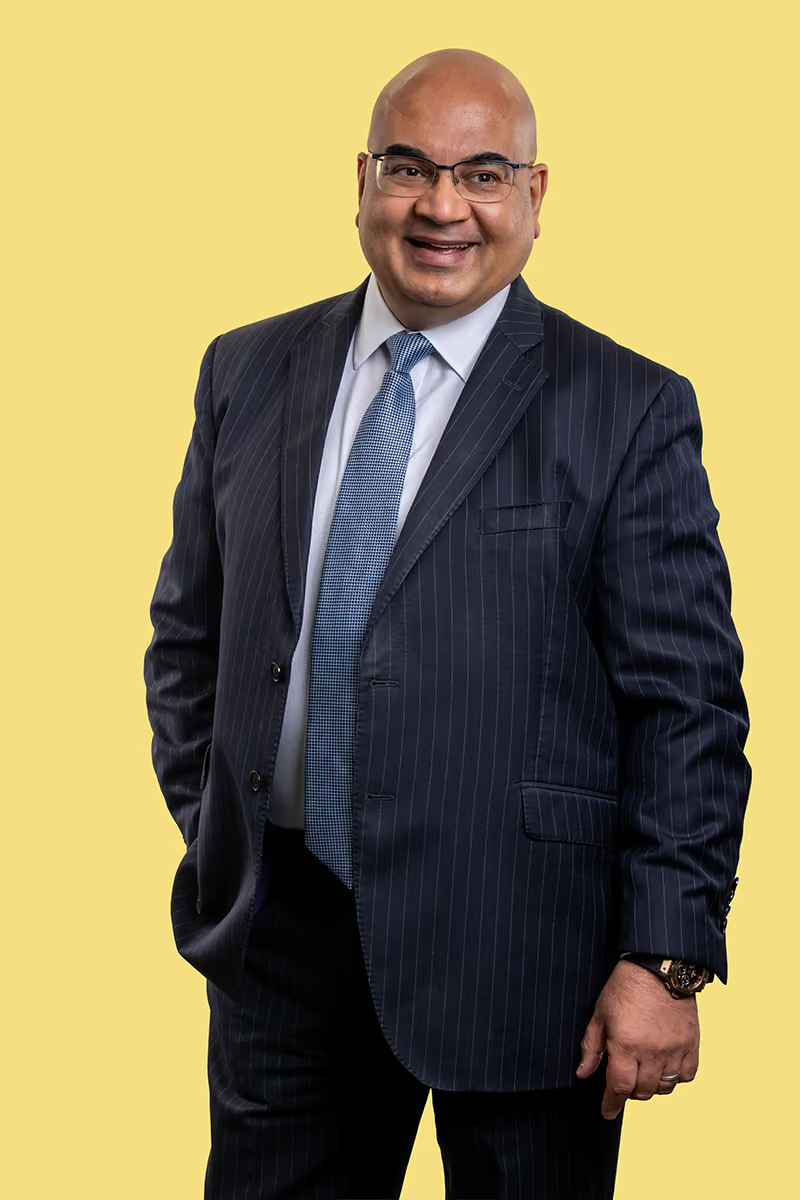
Luke Patel
Luke Patel is a Partner and Head of our Commercial Dispute Resolution team. He is recognised by The Legal 500 as “very client focused, driven by getting the right outcome for his clients and always delivering an impeccable service."
More from the blog
Lorem ipsum dolor sit amet, consectetur adipiscing elit. Aliquam eu venenatis felis. Nulla placerat in nulla in eleifend. Donec placerat velit eget nulla.